

Indonesia Brings Language Diplomacy to Global Education Forum at UNCC Bangkok
Indonesia promotes BIPA as language diplomacy at GCE 2026 in Bangkok to bolster international educational cooperation and support UN Sustainable Development Goal 4.
PROBOLINGGO – Indonesia’s language diplomacy took center stage at the Global Conference on Education for a Sustainable Future (GCE 2026), held on 11–12 February 2026 at the United Nations Conference Centre (UNCC), Bangkok. In the forum, Dewi Puspa Arum, a lecturer at Universitas Pembangunan Nasional “Veteran” Jawa Timur, introduced BIPA (Bahasa Indonesia bagi Penutur Asing/Indonesian for Foreign Speakers) as a strategic approach to strengthening international educational cooperation.
The conference was organized by the Sustainable Development Council (UNSDC), an international organization with Special Consultative Status with the United Nations Economic and Social Council (ECOSOC). It brought together ministers, ambassadors, university leaders, researchers, and youth leaders from various countries to discuss education system transformation in support of Sustainable Development Goal (SDG) 4, which focuses on inclusive and equitable quality education.
The opening session featured leading figures in education and diplomacy, including Dr. Datchanamoorthy Ramu, Founder Chairman of the Sustainable Development Council; Yeezang De Thapa, Minister for Education and Skills Development of Bhutan; and Faiyaz Murshid Kazi, Ambassador of Bangladesh. Also present were Michel Parys, Ambassador of Belgium; Andrew Egan, Permanent Representative of Australia to ESCAP; and Dr. Phichet Phophakdee, Secretary-General of Thailand’s Basic Education Commission.
In his opening remarks, Dr. Datchanamoorthy Ramu stressed the urgency of international collaboration in strengthening global education systems.
“Education is the foundation of the world’s future. To address global challenges, we need cross-border collaboration, learning innovation, and educational leadership capable of bringing real change,” he said.
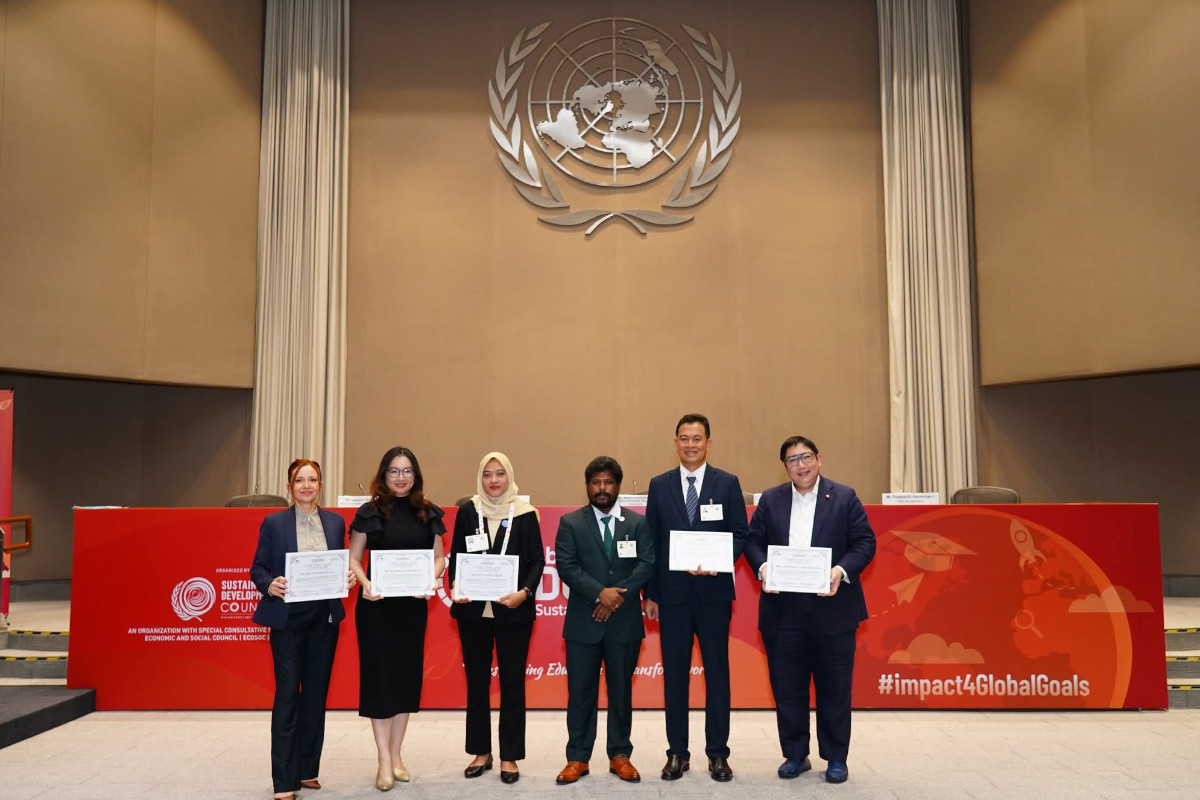
Other international speakers included former Malaysian Deputy Minister of Education Datuk P. Kamalanathan, Finnish Ambassador Kristiina Kuvaja-Xanthopoulos, Bahraini Ambassador Khalil Yaqoob AlKhayat, Giovanni Jing from a UNESCO-affiliated education research center, and Prof. Gauri Dutt Sharma, Vice Chancellor of the University of Science & Technology Meghalaya, India.
Indonesia’s perspective was presented in Technical Session I, titled “Strengthening Education Systems for the Implementation of Sustainable Development Goal 4,” held on 11 February 2026, 11.30 a.m.–12.30 p.m. Thailand time, and moderated by Dr. Melisa Ayşegül Çal of Suan Sunandha Rajabhat University.

The panel also featured Thepparith (Teejay) Senamngern, Founder & CEO of Ad Astra Asia Company Limited; Dr. Napasri Suwanjote, Dean of the Faculty of Humanities and Social Sciences at Suan Sunandha Rajabhat University; and Dr. Ongart Namwong from the Faculty of Education at Khon Kaen University.
In her presentation, “BIPA as Language Diplomacy for SDG 4: Cultural and ASEAN Cooperation,” Dewi Puspa Arum positioned BIPA as a strategic instrument of educational diplomacy.
“Language plays a broader role than merely serving as a means of communication. Through language learning, we build cultural understanding while also opening up space for educational collaboration among nations,” she said.
Dewi Puspa Arum argued that strengthening education systems depends not only on national policy, but also on institutional practice. In the BIPA context, she said this can be pursued through cross-institutional curriculum alignment, stronger quality assurance in language learning, the integration of language and culture in international education, and the use of digital and blended learning.
She added that this approach can support international academic mobility while reinforcing regional educational cooperation, particularly across ASEAN.
Her perspective is grounded in extensive experience in Indonesian language education. In addition to being a lecturer in Indonesian Linguistics at UPN “Veteran” Jawa Timur, Dewi Puspa Arum is also Head of the Laboratory of the Indonesian Linguistics Study Program and Coordinator of the KNB BIPA Program. She also serves as a National Language Ambassador in a program run by the Language Development and Fostering Agency, Ministry of Primary and Secondary Education of the Republic of Indonesia.
These roles reinforce her contribution to promoting Indonesian internationally while advancing BIPA as part of language diplomacy and global educational cooperation.
Over the two-day conference, GCE 2026 addressed major global education agendas, including Inclusive and Equitable Education, Future-Ready Education and Lifelong Learning, and Digital Transformation in Education: Governance, Equity, and Quality Considerations. The themes shaped discussions on building more inclusive, adaptive, and sustainable education policies and practices worldwide.
The forum brought together academics, governments, development organizations, and education technology innovators to strengthen global collaboration for the implementation of SDG 4.
Dewi Puspa Arum’s participation reflects the growing contribution of Indonesian academics to international education diplomacy. Through language and culture, Indonesia is expanding regional educational cooperation in ASEAN while strengthening its global academic network.
Her presence at the forum also highlights UPN “Veteran” Jawa Timur’s commitment to advancing the internationalization of education and cross-border academic collaboration.
Dewi Puspa Arum expressed appreciation to the Sustainable Development Council (UNSDC) for the opportunity to contribute to the global forum, and to UPN “Veteran” Jawa Timur for the institutional support that made her international participation possible.
With the theme “Transforming Education to Transform the World,” the conference reaffirmed education as the main foundation for building an inclusive and sustainable global future. In that context, BIPA’s language diplomacy model showed how language can serve as a bridge for cross-border educational collaboration while strengthening Indonesia’s role in the global education conversation. (*)
Simak breaking news dan berita pilihan TIMES Indonesia langsung dari WhatsApp-mu! Klik 👉 Channel TIMES Indonesia. Pastikan WhatsApp kamu sudah terpasang.
Berita ini juga tayang di portal nasional
Baca versi lengkapnya di jaringan nasional kami.
